

NRI Mental Health & Depression in the USA: Finding Support
13 July, 2026
9 Shares
106 Reads
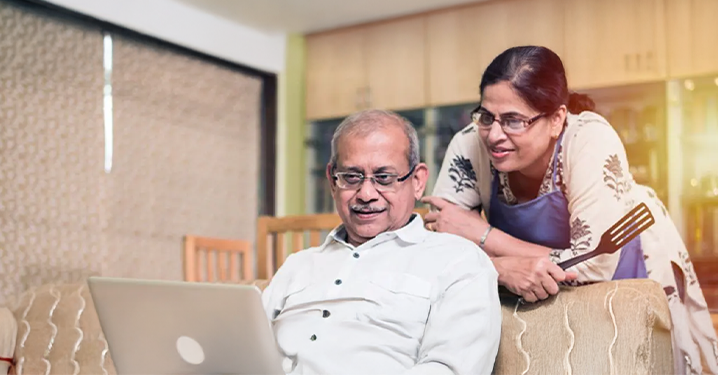
Here is a number worth pausing on: over 58% of NRIs experience emotional distress at some point after moving abroad. Not occasional homesickness. Not post-flight fatigue. Genuine, sustained emotional distress in people who are, by every visible measure, doing well. Good jobs, decent apartments, Sunday calls home. And still, most mornings, something feels hollowed out. Not homesick exactly. Not unhappy exactly. Just disconnected in a way that does not have a clean name.
Most of these people would never use the word 'depressed.' That word, in the Indian community, belongs to people with real problems. Which is precisely why the problem persists. The silence around mental health support in NRI communities is not a weakness; it is the product of a culture that has never had much language for the middle ground between fine and broken. This blog covers what that middle ground looks like, why the stigma runs deeper in immigrant communities, and where to find genuine help.
Why NRIs in the USA Are Particularly Vulnerable
Immigration is hard. That is not a generic observation; it is a specific set of pressures that stack on top of each other in ways that are easy to underestimate from the outside.
The Performance Pressure Trap
Moving to the USA comes with a weight that most people do not name out loud: the weight of justifying the move. Family expectations, visa dependencies, and a self-imposed standard of visible success mean that admitting struggle feels like failing the people who believed in you. Research shows that Indian immigrants report lower life satisfaction than American-born counterparts despite comparable financial success, which tells you that income and well-being are not the same thing, even if the community treats them as if they were.
Isolation That Does Not Look Like Isolation
NRI isolation is not the obvious kind. The calendar is full of work, calls home, and weekend gatherings with other Indians. But surface connection is different from the deep familiarity of a lifelong community. The primary emotions researchers find immigrants associate with separation are loneliness, frustration, and sadness, and when those go unnamed long enough, they become something heavier.
Identity Strain: Belonging to Neither
Life between two cultures can create a feeling of being caught between worlds. Indian enough at home, not American enough at work. The in-between space has a quiet psychological cost that accumulates over the years rather than announcing itself on any particular day. Many NRIs describe a persistent identity confusion, a sense of performing a version of themselves that does not quite fit, in either direction.
Life Events with No Support Buffer
A parent's hospitalisation in India, a job loss, a relationship breakdown, these are hard in any context. They hit differently when your nearest support system is 12 time zones away. The practical logistics of handling a family crisis from across the world are exhausting. The emotional cost of handling it alone is something else entirely.
The 'Log Kya Kahenge' Factor
The fear of community judgment in tight-knit Indian-American circles is not imaginary. Word travels. Seeking mental health support can feel like a public admission, and in communities where reputation is a shared family asset, that risk feels real. The result is that many people downplay their struggles not just to themselves, but to everyone around them.
What Depression and Anxiety Actually Look Like in NRI Life
Clinical symptom lists describe depression in ways most people do not recognise in themselves. Here is what it actually looks like in an NRI context:
- Functioning at work, feeling nothing after hours. The professional self holds. Everything else goes quiet.
- Avoiding calls home. Not because there is nothing to say, but because explaining how you actually feel would worry them, so you say you are fine, and then feel more alone.
- Irritability without an obvious cause. Fatigue that sleep does not fix. A sense of moving through the day on a low battery.
- Not belonging anywhere. Not in the USA, not in India anymore either. The feeling that you have drifted from the version of yourself that people back home still think you are.
- Physical symptoms like headaches, digestive issues, and disrupted sleep. Many NRIs express emotional distress physically before they name it emotionally and then treat the symptom without addressing the cause.
- The gratitude loop. 'I have a good life. Other people have it worse. I have no right to feel this way.' This loop does not resolve distress; it buries it.
This pattern is especially pronounced among overseas Indian students in the USA, who face a compounded pressure: academic demands, parental expectations, cultural displacement, and imposter syndrome often simultaneously, and with very little space to talk about any of it.
Why the Stigma Around Mental Health Support Runs Deeper in Immigrant Communities
Understanding why stigma persists is not an academic exercise. It is the first step in loosening its hold.
The Language Gap
Indian culture historically frames mental health as either a spiritual failing or a serious psychiatric condition. There is very little language for the middle ground, the everyday weight of anxiety, adjustment difficulty, grief, or burnout. When there are no words for something, it is very hard to ask for help with it.
First-Generation Pressure
There is an additional layer for first-generation immigrants that is rarely spoken about: the pressure to show that the sacrifice was worth it. Leaving India, leaving family, familiarity, and language is a significant act. Admitting that it has been harder than expected can feel like a betrayal of the decision itself.
The Model Minority Myth
An expectation of South Asian immigrants as inherently successful, high-achieving and hardy makes it even more difficult to acknowledge when this is not you. A study reported in the Asian Journal of Psychiatry suggests that migrant Indians are more susceptible to psychiatric symptoms than other ethnic groups. This clearly conflicts with the "success" perception of this immigrant community.
Men's Compounded Silence
Indian men face a doubled silence: the cultural expectation of stoicism, combined with the immigrant expectation of being the strong one who made it work. The intersection of those two pressures creates a space where asking for mental health support feels almost structurally impossible. Which is precisely why it matters that someone says out loud: it is possible, and it is worth it.
Mental Health Support Options in the USA for NRIs
The practical question, once the decision to seek support is made, is where to start. Here is a clear overview:
Crisis Resources: If You Need Help Right Now
If you or someone you know is in crisis: Call or text 988 (Suicide & Crisis Lifeline, USA 24/7). Text HOME to 741741 (Crisis Text Line). Call 1-800-662-4357 (SAMHSA National Helpline, free, confidential, 24/7).
Full Support Directory
The table below covers verified mental health support resources for NRIs in the USA, from crisis lines to culturally competent therapy directories:
Finding a Culturally Competent Therapist
Not all therapy is equal for NRI patients. A therapist who understands the specific texture of the immigrant experience, the identity strain, the family dynamics, and the cultural frameworks around emotion is meaningfully more effective than a general practitioner. Both Psychology Today's South Asian filter and the South Asian Therapists directory allow you to search specifically for therapists who work with this community. Telehealth options mean geography is no longer a barrier, and many practitioners work across time zones for NRIs who split time between India and the USA.
Community and Peer Support
Formal therapy is not the only form of mental health support. Peer communities, people who understand the NRI experience from the inside, provide something different: the recognition that comes from being genuinely understood. NAMI's South Asian community programmes, Mind Share Partners, and online communities on Reddit and Instagram all offer this kind of connection. They are not a substitute for professional care when it is needed, but they are a meaningful part of the support picture.
Self-Help Starting Points
- Establish a routine. Consistency in sleep, meals, and exercise has a measurable effect on mood. It is not a cure, but it creates a foundation.
- Mindfulness apps. Calm and Headspace are both well-evidenced and accessible. Even 10 minutes daily over a few weeks shows measurable changes in anxiety levels.
- Maintain India-time connections without guilt. Regular contact with family and friends back home matters. The key is to make it sustainable, not a performance of being fine, but a genuine connection.
- Join local Indian community groups. Not for the social calendar, but for the sense of familiar ground. Shared cultural context reduces the isolation that underpins a lot of NRI mental distress.
Conclusion
Mental health support is not a Western concept imported into Indian culture; it is simply what looking after yourself looks like when the usual support systems are far away. The stigma that surrounds it in NRI communities is real, but it is not permanent. It loosens with every honest conversation, every person who decides that their inner life deserves as much attention as their career or their visa status. Proper financial protection through NRI health insurance ensures that getting clinical help doesn't balance against your savings.
Niva Bupa's comprehensive health insurance plans include mental health coverage as part of holistic care because the mind and the body are not separate concerns. Our network covers over 10,400 hospitals across India for cashless hospitalisation when you travel back home. For NRIs who want to ensure their health cover addresses the full picture, mental health benefits are worth verifying at Niva Bupa.
Frequently Asked Questions
1. Why do NRIs in the USA struggle with mental health?
NRIs face a specific combination of stressors: performance pressure, cultural isolation, identity strain from living between two cultures, distance from family support systems, and community stigma around mental health support. Over 58% experience emotional distress at some point after moving abroad.
2. What mental health support is available for NRIs in the USA?
NRIs in the USA can access the 988 Suicide & Crisis Lifeline (call or text 988), SAMHSA National Helpline (1-800-662-4357), culturally competent therapists via the South Asian Therapists directory (southasiantherapists.org), Psychology Today's South Asian filter, NAMI HelpLine (1-800-950-6264), and iCall for online sessions.
3. Is depression common among Indian immigrants in the USA?
Yes. Research shows Indian-Americans face an elevated risk of psychiatric symptoms due to their migrant status. Overseas Indian students face compounded pressures, including academic stress, parental expectations, and cultural displacement. Yet cultural stigma keeps most from seeking professional mental health support.
Get right coverage, right premium and the right protection instantly.
 By clicking, I agree to Niva Bupa
 You may also like



Health Insurance - Health Insurance | Best Family Health Insurance | Best Health Insurance For Senior Citizens In India | Health Insurance With Opd Cover | Mediclaim Insurance | Critical Illness Insurance | Personal Accident Insurance | Mediclaim Policy | Individual Health Insurance | Maternity Insurance | Best Health Insurance company | NRI Health Insurance
Health Insurance Schemes - PMMVY Login | PMJJBY Policy Status | Swasthya Sathi Card | PMSBY | PMJJBY | Ayushman Card | PMMVY 2.0 | Ayushman Vay Vandana Card | PMMVY NIC IN रजिस्ट्रेशन | PMMVY 2.0 लॉगिन
Travel Insurance Plans - Travel Insurance | International Travel Insurance | Student Travel Insurance | Travel Insurance USA | Travel Insurance Canada | Travel Insurance Thailand | Travel Insurance Germany | Travel Insurance Dubai | Travel Insurance Bali | Travel Insurance Australia | Travel Insurance Schengen | Travel Insurance Singapore | Travel Insurance UK | Travel Insurance Vietnam | Travel Insurance Japan | Travel Insurance Spain | Travel Insurance Asia | Travel Insurance Netherlands | Travel Insurance Turkey | Travel Insurance Ireland | Travel Insurance Philippines | Travel Insurance Italy | Travel Insurance France | Travel Insurance China | Travel Insurance Georgia | Travel Insurance South Africa | Travel Insurance Maldives | Travel Insurance Portugal | Travel Insurance Malaysia | Travel Insurance Qatar | Travel Insurance Poland | Travel Insurance Greece | Travel Insurance New zealand | Travel Insurance Saudi Arabia | Travel Insurance Sri Lanka
Become an Agent - Insurance Agent
Top Hospitals - Best Hospitals in Gurgaon
Others - Ayushman Bharat | Gst Refund for NRI on Health Insurance Premium
Health & Wellness - शिलाजीत के फायदे हिंदी | Weight Gain Diet in Hindi | Sat Isabgol Uses In Hindi | Aloe Vera Juice Benefits in Hindi | Dragon Fruit Benefits in Hindi | Akal Daad in Hindi | Acidity Home Remedies in Hindi | Nikat Drishti Dosh in Hindi | Yoga Benefits in Hindi | Laung Khane ke Fayde in Hindi | Leukoplakia in Hindi | Protein in 100g Paneer | Benefits of Rice Water For Skin | B12 Deficiency Symptoms in Hindi | Fibre Foods in Hindi | Chronic Disease Meaning in Hindi | Vitamin D Foods in Hindi | Blood Urea in Hindi | Beetroot Uses Good for Health
Calculator - BMI Calculator | Pregnancy Calculator | Pregnancy Calendar Based on Conception Date | Pregnancy Conception Date Calculator | Last Menstrual Period Calculator | BMR Calculator | GFR Calculator | Ovulation Calculator



www.nivabupa.com

+91 11 30902010

1860-500-8888

CIN: L66000DL2008PLC182918
IRDAI Registration No. 145

Corporate Office: 3rd Floor, Capital Cyberscape, Sector 59, Gurgaon
Registered Office: C-98, First Floor, Lajpat Nagar, Part 1, Delhi-110024, India


