
Is LASIK Eye Surgery Covered by Your Health Insurance Plan?
18 July, 2025
5 Shares
2631 Reads
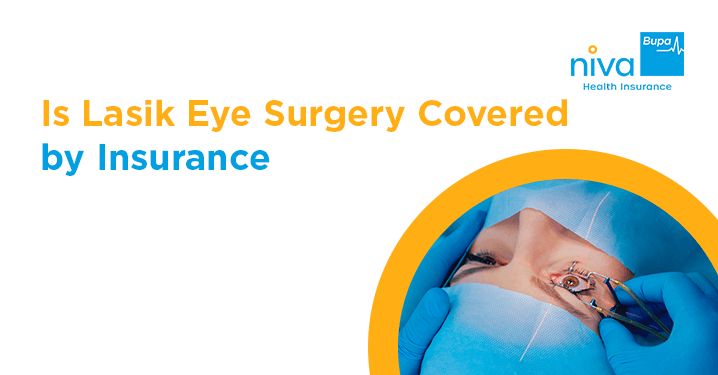
LASIK eye surgery is a cosmetic refractive procedure, which is taken into account as an elective rather than mandatory. Does that mean coverage for it is not possible? No, coverage is available only when your ophthalmologist's documents show it as a medical necessity, and the policy wording or a vision rider allows it. Though IRDAI sets common waiting periods and exclusions for every insurer, it still doesn’t make LASIK a default benefit in any health insurance.
LASIK promises life without glasses, but the bill often arrives before your insurer's answer. Most standard health policies call it elective. Any cover depends on documented medical necessity, your policy wording, and whether you have a rider. Sorting this out early can save you from a rejected claim and let you choose a payment route while there's still time, such as a rider or an employer benefit.
Is LASIK Covered Under Health Insurance?
LASIK is an elective procedure. This usually means your health insurance won't cover it, unless you have a prescription from your doctor and your policy specifically covers it. The IRDAI Master Circular for the Health Insurance Business (IRDAI/HLT/CIR/PRO/84/5/2024), dated 29 May 2024, standardises wording and exclusions for all insurers and doesn't require them to cover LASIK procedures.
Why Do Insurers Treat LASIK as Elective?
Insurers cover sickness or injury, while people undergo LASIK to be less reliant on glasses. Hence, it can be concluded that it is part of the cosmetic/refractive exclusion clause since it is not a medical necessity; it is just a preference. For example, Zorawar is 31 years old and has been having the same spectacle power for quite some time. He is healthy and frustrated by his dependence on glasses. There is nothing wrong with his eyes; therefore, his claim will be considered under the refractive or cosmetic exclusion clause.
What Does the Regulator Standardise (and What Does It Not)?
The regulator sets standards for waiting periods and exclusions, but leaves it to the policyholder to decide whether LASIK is payable. This depends on the wording of the exclusions in one's policy document and any applicable rider. The IRDAI Master Circular (IRDAI/HLT/CIR/PRO/84/5/2024) is useful for understanding how a claim for refractive surgery would be handled, and it should be compared with the schedule in the policy document.
How Long Can a Waiting Period Be?
A pre-existing disease (PED) or specific-condition waiting period cannot exceed 36 months as per the IRDAI Master Circular. An insurer will evaluate a claim for a vision-related procedure under such waiting periods against the waiting period, even if it is deemed medically necessary.
What Does the 60-Month Moratorium Mean for You?
Once you've completed 60 continuous months of cover, the IRDAI Master Circular says no policy or claim can be contested, except for proven fraud or permanent exclusions. Imagine Dhairyaveer, who has held continuous cover for 62 months. His claim can't be challenged on settled grounds. Still, if his policy lists refractive surgery as a permanent exclusion, the moratorium won't turn LASIK into a covered benefit. The policy wording comes first, every time.
Is Elective LASIK Treated Differently From Medically Necessary LASIK?
Yes. Elective correction is usually excluded. A documented medical need, however, may be assessed against your policy wording, waiting period, and sub-limit. The table below compares three common situations.
What If Your Ophthalmologist Documents a Medical Need?
Then you have a strong case to pursue, but no guarantee of getting money back. Medical necessity means your ophthalmologist explains on the form why they believe the procedure is essential for your medical or functional needs, supported by your refraction and diagnostic reports. Your claim is then assessed against your exclusion clause, waiting period, and sub-limit.
Say a case of Tejasvini, 38 years old: her ophthalmologist puts in writing why her spectacles are no longer working for her. She gets her hand on the certificate, her record of refractions, and diagnostic reports and comes to us to find out if her policy wording or rider clause allows for consideration of this claim. The fact remains that her claim will be assessed against her exclusion, waiting period, and sub-limit; hence, she checks these before surgery rather than after.
What If LASIK Is Not Suitable for You?
Conditions such as keratoconus can rule LASIK out, and your ophthalmologist may suggest an alternative like PRK, LASEK, or an IOL. That recommendation goes through the same criteria for medical necessity and policy terms. Consider Ojasvi, 26, who learns he has keratoconus. LASIK is off the table for him, so his doctor advises an alternative. His claim for that alternative is assessed under his policy, with the ophthalmologist's assessment and corneal imaging as his key documents.
Which Niva Bupa Plans Mention LASIK or Refractive Error Cover?
Several Niva Bupa plans offer refractive-error surgery in their wording, and each sets its own conditions, so the product you hold determines the answer. The table summarises what the product documents say. Your policy schedule overrides any summary, including this one.
What Does This Look Like in Practice?
In practice, it comes down to a few questions. Imagine Vrishank, who has a Health Premia Gold plan and a high refractive error for which his ophthalmologist has prescribed LASIK. Going by the wording above, that points toward possible cover. He still checks whether his 36-month waiting period is complete, which sub-limit applies, and whether his policy year matches the wording he read. Then he asks us for written confirmation before he books a date.
What Other Refractive Procedures Exist Besides LASIK?
The main options to consider instead of LASIK are PRK, LASEK, and IOL treatments. Whether any of them will be right for you depends on your health condition and should be determined by a professional ophthalmologist.
According to the NIH National Eye Institute, LASIK is the most appropriate procedure for adults with stable refractive errors. LASIK is contraindicated for patients with keratoconus, dry eye, glaucoma, cataracts, and large pupils. Refractive error is one of the leading causes of impaired vision worldwide. This makes it a medical, not cosmetic, procedure.
How Much Does LASIK Cost in India?
Estimates suggest LASIK in India costs between ₹25,000 and ₹1,20,000 per eye. This is only an estimate, as factors such as technology, city, and service provider can change the price drastically. For comparison, NSS 2025 data by PIB puts the out-of-pocket expense for hospitalisation at around ₹34,064 (not for childbirth). This is the mean value, while the median stands at ₹11,285. If your health insurance plan does not cover the procedure, you will have to pay the total expense out of pocket.
Does Corporate or Group Health Insurance Cover LASIK?
Some Employers may also include wellness coverage under their group health insurance, but the extent of the coverage varies from employer to employer and from one policy period to another. Take Kshitija. A colleague has noted that some of their LASIK surgery costs have been covered under their plan and asks if the same applies to her. Rather than guessing, she emails HR or the benefits department to ask whether they include LASIK, a vision rider, or elective procedures as part of their plan, and she requests the exclusion wording in writing. One email like that shows her what she can plan around safely.
Do Health Insurance Premiums Offer Any Tax Benefits?
GST on individual health insurance premiums was removed from September 22, 2025. For income tax, premiums for you and your family earn a deduction of up to ₹25,000 under Section 126. A parents’ policy that you fund brings another ₹25,000. Only the premium counts, so procedures like LASIK stay outside it.
What Should You Verify in Your Policy Before Booking LASIK?
There are six things to be checked, and we recommend that you verify them in writing with your insurer before scheduling the surgery.
Vision or LASIK rider (if any) and the amount covered
How the exclusion is worded for refractive and cosmetic procedures
The waiting period (if any), which includes initial, specific disease, or PED waiting
Any sub-limit and/or co-pay applicable to the procedure (per eye or per claim)
Documentation required from your ophthalmologist (medical-necessity certificate, refraction, and diagnostic reports)
Claim settlement through cashless at the network provider or reimbursement.
Conclusion
LASIK is generally an elective surgery and is usually not covered under your insurance plan; coverage is possible only if medical necessity is documented and your policy wording or rider allows it. Check your exclusion clause, ask about riders and group benefits, and keep your documents handy. Then contact Niva Bupa and get our answer in writing before you book.
Medically Reviewed and Medical Disclaimer
This piece is informational for Indian health-insurance readers and is not medical advice. Refractive-surgery suitability, risks, and outcomes must be evaluated by a qualified ophthalmologist. The coverage statements here are indicative of a standard policy practice and the IRDAI framework and are not a guarantee of payment. Read your policy schedule, exclusion list, and rider documents and confirm the details with Niva Bupa.
Frequently Asked Questions
Is LASIK covered under Niva Bupa?
It is not covered as a matter of course. LASIK treatment can be viewed as an elective procedure and therefore does not fall under normal coverage. However, it may be covered if your plan allows it and you have a note from your ophthalmologist. Confirm in writing with Niva Bupa before surgery.
Is LASIK covered under corporate or group health insurance?
This could be the case if, for example, your workplace has a corporate health plan that includes vision care. In any case, always ask your human resources department in writing what the plan does not cover.
Does health insurance cover PRK, LASEK, or IOL instead of LASIK?
If the surgery is deemed medically necessary and the exclusion language and riders permit it, other appropriate alternatives such as PRK, LASEK, and IOL surgery are also considered within the guidelines of LASIK. Suitability for the different procedures is a matter of professional judgment by the ophthalmologist, according to the NIH National Eye Institute.
What documents help a LASIK medical-necessity claim?
Keep the medical necessity certificate issued by the eye doctor, your prescription and refractive records, and the policy's exclusion clause. Claim evaluation will be dependent on the 36-month PED cap and 60-month moratorium in the IRDAI master circular.
Is the cost of LASIK covered if I pay out of pocket?
If it is not covered by insurance, you will have to pay out of pocket. According to market information, the cost can range from ₹25,000 to ₹1,20,000 per eye and may vary.
Get right coverage, right premium and the right protection instantly.
 By clicking, I agree to Niva Bupa
 You may also like



Popular Searches
Health Insurance - Health Insurance | Best Family Health Insurance | Best Health Insurance For Senior Citizens In India | Health Insurance With Opd Cover | Mediclaim Insurance | Critical Illness Insurance | Personal Accident Insurance | Mediclaim Policy | Individual Health Insurance | Maternity Insurance | Best Health Insurance company | NRI Health Insurance
Health Insurance Schemes - PMMVY Login | PMJJBY Policy Status | Swasthya Sathi Card | PMSBY | PMJJBY | Ayushman Card | PMMVY 2.0 | Ayushman Vay Vandana Card | PMMVY NIC IN रजिस्ट्रेशन | PMMVY 2.0 लॉगिन
Travel Insurance Plans - Travel Insurance | International Travel Insurance | Student Travel Insurance | Travel Insurance USA | Travel Insurance Canada | Travel Insurance Thailand | Travel Insurance Germany | Travel Insurance Dubai | Travel Insurance Bali | Travel Insurance Australia | Travel Insurance Schengen | Travel Insurance Singapore | Travel Insurance UK | Travel Insurance Vietnam | Travel Insurance Japan | Travel Insurance Spain | Travel Insurance Asia | Travel Insurance Netherlands | Travel Insurance Turkey | Travel Insurance Ireland | Travel Insurance Phillipines | Travel Insurace Italy | Travel Insurance France | Travel Insurance China | Travel Insurance Georgia | Travel Insurance South Africa | Travel Insurance Maldives | Travel Insurance Portugal | Travel Insurance Malaysia | Travel Insurance Qatar | Travel Insurance Poland | Travel Insurance Greece | Travel Insurance New zealand | Travel Insurance Saudi Arabia | Travel Insurance Sri Lanka
Become an Agent - Insurance Agent | IRDA Certificate Download | IRDA Exam Syllabus | IRDA exam fee | Paise Kaise Kamaye | Ghar Baithe Paise Kaise Kamaye
Top Hospitals - Best Hospitals in Gurgaon
Others - Ayushman Bharat | Gst Refund for NRI on Health Insurance Premium
Health & Wellness - शिलाजीत के फायदे हिंदी | Weight Gain Diet in Hindi | Sat Isabgol Uses In Hindi | Aloe Vera Juice Benefits in Hindi | Dragon Fruit Benefits in Hindi | Akal Daad in Hindi | Acidity Home Remedies in Hindi | Nikat Drishti Dosh in Hindi | Yoga Benefits in Hindi | Laung Khane ke Fayde in Hindi | Leukoplakia in Hindi | Protien in 100g Paneer | Benefits of Rice Water For Skin | B12 Deficiency Symptoms in Hindi | Fibre Foods in Hindi | Chronic Disease Meaning in Hindi | Vitamin D Foods in Hindi | Blood Urea in Hindi | Beetroot Uses Good for Health
Calculator - BMI Calculator | Pregnancy Calculator | Pregnancy Calendar Based on Conception Date | Pregnancy Conception Date Calculator | Last Menstrual Period Calculator | BMR Calculator | GFR Calculator | Ovulation Calculator


www.nivabupa.com

+91 11 30902010

1860-500-8888

CIN: L66000DL2008PLC182918
IRDAI Registration No. 145

Corporate Office: 3rd Floor, Capital Cyberscape, Sector 59, Gurgaon
Registered Office: C-98, First Floor, Lajpat Nagar, Part 1, Delhi-110024, India


